
SOLUTION
Cyber Risk Management

Proactive Defense
Move beyond reactive fixes with continuous monitoring, vulnerability assessments, and threat modeling aligned to frameworks like NIST, ISO 27001, GDPR, and DORA.
By anticipating risks before they escalate, you strengthen both your security posture and stakeholder confidence.
“Our business is global and changes daily. The ability to easily move plans and folders within CLDigital with no coding saves us a ton of time every year.”
Chief Information Officer
- Large Insurance Company (UK)
“CLDigital gave us real-time visibility and control, bringing risk and compliance into one coherent view.”
Chief Risk Officer
- Global Financial Institution (UK)
“We replaced dozens of spreadsheets and legacy systems with one intuitive dashboard with no code required.”
Enterprise Risk Manager
- U.S. Healthcare Organization
Readiness You Can Prove
Demonstrating cyber resilience isn’t optional, it’s a regulatory and business imperative.
Document controls, map risks to business impact, and maintain real-time audit trails that make proving compliance straightforward.
You’ll be prepared not just to respond, but to show regulators, auditors, and boards that your defenses hold up.
BENEFITS
Anticipate Cyber Threats
Protect Digital Assets
Demonstrate Readiness
Reduce Breach Impact
The Four-Step Cyber Risk Management Process
Most frameworks break cyber risk management into four repeating stages. Understanding this cycle clarifies how continuous visibility and compliance readiness connect.
1. Identify Assets and Threats
The first step involves cataloging your digital assets: servers, databases, cloud services, IoT devices, and third-party connections. From there, you document the threats each asset faces, from ransomware and phishing to insider errors and supply chain vulnerabilities.
You can’t protect what you don’t know exists, so this inventory becomes your foundation. Many organizations discover during this phase that they have far more exposed assets than they realized, particularly in cloud environments where teams spin up resources quickly.
2. Assess Likelihood and Impact
Next comes evaluation. How probable is each threat, and what’s the potential business and financial impact if it materializes? A business impact analysis helps you understand which systems, if compromised, would disrupt revenue, customer trust, or regulatory standing.
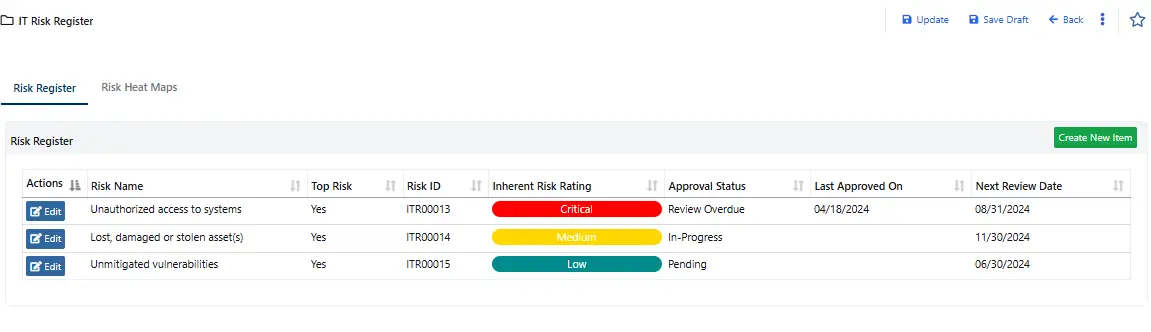
This step transforms a long list of vulnerabilities into a prioritized risk register. Instead of treating every finding as equally urgent, you can focus attention on the risks that matter most to your organization’s specific context.
3. Respond with Controls and Treatments
Once you’ve ranked your risks, the next question is how to address each one. Four common responses exist:
- Mitigate: Apply security controls like multi-factor authentication, encryption, or network segmentation to reduce exposure.
- Transfer: Shift financial liability through cyber insurance or contractual agreements with vendors.
- Avoid: Discontinue the risky activity or retire the vulnerable system entirely.
- Accept: Acknowledge the risk when the cost of mitigation exceeds the potential damage, documenting your rationale for auditors.
Your organization’s risk tolerance, meaning the level of risk leadership is willing to accept, guides these decisions. What’s acceptable for a startup may be unacceptable for a regulated financial institution.
4. Monitor and Reassess Continuously
Threats evolve, new assets come online, and regulations change. Continuous monitoring tracks the effectiveness of your controls and flags emerging risks before they escalate.
This stage closes the loop, feeding new findings back into identification and assessment. Without it, your risk register becomes a snapshot that grows stale within weeks.
FAQ
Solution FAQs
What is Cyber Risk?
What are the key functionalities of Cyber Risk?
What are the benefits of Cyber Risk?
What are the challenges of Cyber Risk?
GET STARTED
Let's Connect
Discover how our platform can help you achieve better outcomes and you prepare for what’s next in risk and resilience.