
SOLUTION
Supply Chain
Supply chain risk management (SCRM) is the systematic process of identifying, assessing, and mitigating threats that can disrupt the flow of goods, information, and money across your supplier network. It protects your business from delays, unexpected costs, and operational shutdowns by creating visibility into vulnerabilities you might not know exist.
A single supplier failure three tiers deep in your network can halt production lines, delay customer orders, and erode margins before you even understand what happened. This guide covers the core framework for managing supply chain risks, the common threat categories you’ll encounter, and how to build operations that don’t just survive disruptions but grow stronger because of them.
What Is Supply Chain Risk Management
Supply chain risk management (SCRM) is the process of finding, judging, and fixing dangers that can stop the flow of goods, information, and money across your supplier network. It protects your business from delays, unexpected costs, and shutdowns. The work follows a continuous cycle: map out every step and supplier to spot weak points, measure how likely a bad event is and how much harm it could cause, create backup plans like using multiple suppliers or holding extra stock, and track weather, politics, and market trends to catch new threats early.
What makes SCRM different from general risk management is its focus on relationships between organizations. Your business doesn’t operate in isolation. You depend on suppliers who depend on their own suppliers, and a problem anywhere in that chain can ripple forward to affect your customers. SCRM looks at the entire network, not just your own four walls.
The Blind Date
Traditional GRC checks the box. The risk lives between the boxes.
Tier-N opacity
Hidden concentration
Signals without a system
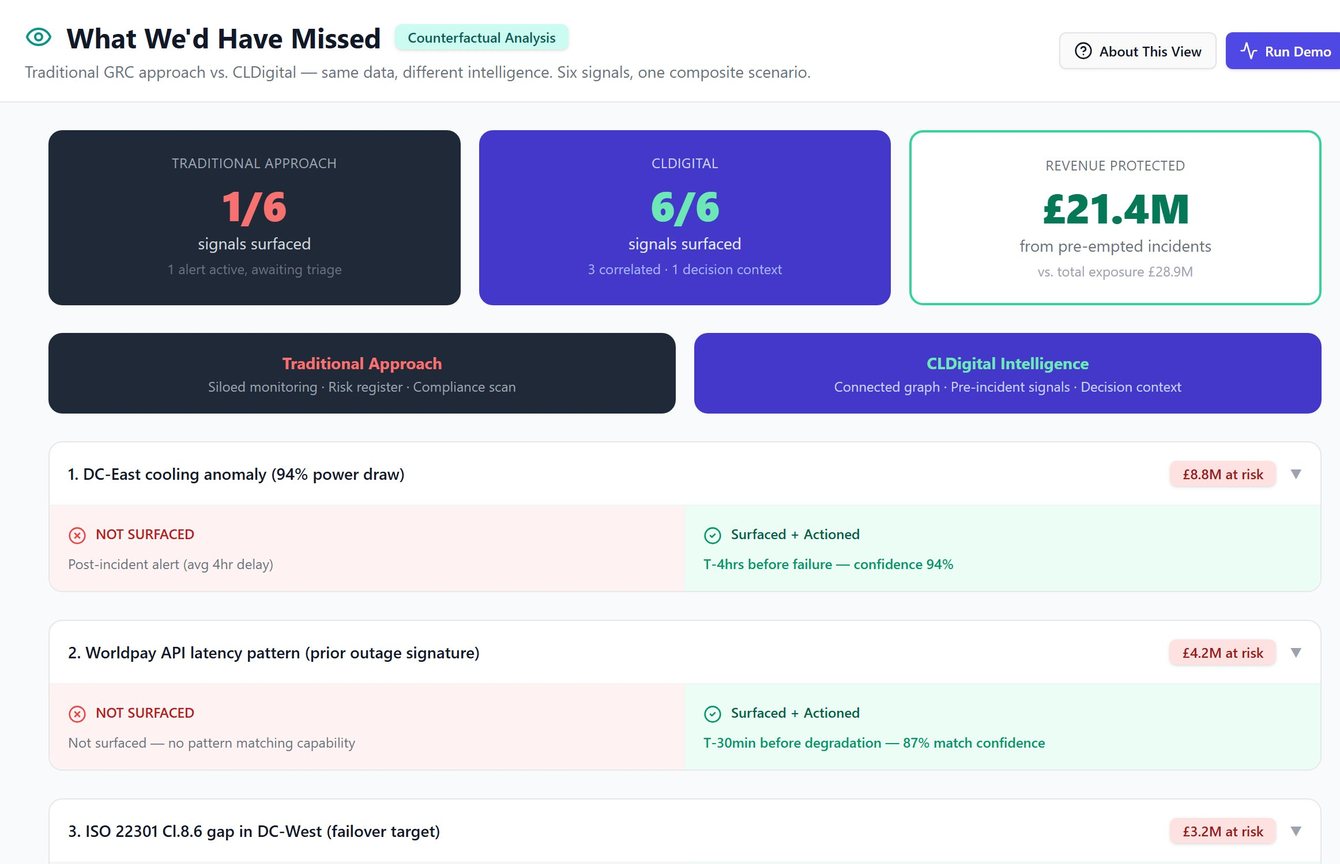
5 of 6 signals a traditional approach would have missed.
The Anti-Fragility model
A living loop that turns disruption into advantage.
Signal ingestion
The living enterprise stream — supplier delays, plant abnormalities, third-party and external signals.
Impact propagation
Trace how a signal moves through dependencies to the business services and revenue it actually threatens.
Decision
Recommended actions pulled from your continuity playbooks, with one-click acknowledgement that triggers workflow.
Learning
Every cycle is captured and scored — learning velocity that compounds, so the next shock costs less.
Common Types of Supply Chain Risks
Supply chain risks come from both inside and outside your organization. Internal risks include equipment failures, quality control problems, and workforce disruptions at your own facilities. External risks sit beyond your direct control and tend to be harder to predict.
- Supply risk: vendor bankruptcy, factory fires, raw material shortages, or quality failures at any level of your supplier network
- Demand risk: sudden shifts in what customers want, unexpected order surges, or market downturns that leave you with unsold inventory
- Environmental risk: natural disasters, pandemics, or climate events that affect multiple locations at once
- Geopolitical risk: trade disputes, sanctions, regulatory changes, or political instability in regions where your suppliers operate
- Cyber risk: data breaches, ransomware attacks, or system failures that cut off visibility and communication
Each type calls for different responses. A supplier going bankrupt requires pre-qualified backup vendors. A cyberattack demands IT security protocols and incident response plans. Knowing which risks you face helps you focus your attention where it matters most.
Why Traditional Approaches Miss Tier-N Exposure
Most organizations have decent visibility into their direct suppliers, the companies they contract with and pay. The trouble lies deeper in the network. Your tier-one supplier relies on tier-two suppliers, who rely on tier-three suppliers, and so on. A disruption several levels removed can cascade forward and reach your operations before you understand what happened.
Traditional risk assessments often stop at tier-one because mapping deeper relationships takes significant effort. Suppliers may be reluctant to share information about their own sources. Yet some of the most damaging supply chain disruptions in recent years started several tiers away from the companies they ultimately affected. The semiconductor shortage that swept through automotive manufacturing, for instance, traced back to capacity constraints at foundries that most automakers had never directly engaged with.
Gaining visibility into hidden dependencies requires tools that can pull data from multiple sources, map relationships automatically, and flag concentration risks you didn’t know existed.
The Supply Chain Risk Management Framework
A structured framework gives your risk management work consistency and repeatability. While specific approaches vary by industry and company size, effective frameworks share four phases that build on each other.
1. Identify Risks Across the Full Network
Start by cataloging every entity in your supply chain: suppliers, logistics providers, warehouses, and distribution centers. Then document the dependencies between them. Which components come from single sources? Which shipping routes pass through congested ports or politically unstable regions?
This mapping exercise often reveals surprises. You might find that two “different” suppliers both rely on the same raw material provider, or that a critical component comes from a single factory in a flood-prone area.
2. Assess Likelihood and Impact
Not all risks deserve equal attention. Assess each identified risk on two dimensions: how likely is it to occur, and how severe would the impact be if it did?
A low-probability, high-impact event (like a major earthquake in a manufacturing hub) requires different treatment than a high-probability, low-impact event (like minor shipping delays during peak season). Risk scoring helps you allocate limited resources to the vulnerabilities that matter most rather than spreading effort thin across everything.
3. Develop Mitigation Strategies
Once you’ve prioritized risks, build response plans for each. Common approaches include:
- Diversification: qualifying multiple suppliers for critical components so you’re not dependent on any single source
- Inventory buffers: holding safety stock for items with long lead times or concentrated sourcing
- Contractual protections: building flexibility and penalty clauses into supplier agreements
- Geographic distribution: spreading production across regions to reduce concentration in any one area
- Scenario planning: developing playbooks for specific disruption types so teams can respond quickly when something happens
4. Monitor and Adapt Continuously
Risk landscapes shift constantly. A supplier that was financially stable last quarter may be struggling now. A trade route that was reliable for years may face new tariffs or congestion.
Continuous monitoring, through financial health tracking, news alerts, and operational metrics, keeps your risk picture current. The best programs treat monitoring as an ongoing discipline rather than an annual checkbox exercise.
Building Anti-Fragile Supply Chain Operations
Resilience means bouncing back from disruptions, returning to where you were before. Anti-fragility goes further. The concept, introduced by author Nassim Nicholas Taleb, describes systems that actually get stronger because of stress and volatility rather than just surviving it.
What does anti-fragility look like in a supply chain? After a disruption, anti-fragile organizations conduct thorough post-incident reviews. They ask not just “what went wrong” but “what did this reveal about our assumptions?” They update their risk models based on real-world data rather than theoretical scenarios. They invest in capabilities that provide optionality, the ability to pivot quickly when conditions change.
Resilient Approach | Anti-Fragile Approach |
Recover to previous state | Emerge stronger than before |
Minimize damage from disruptions | Extract learning from disruptions |
Maintain backup suppliers | Build supplier relationships that improve under stress |
Create static contingency plans | Develop adaptive response capabilities |
The shift from resilience to anti-fragility requires cultural change as much as process change. Teams benefit from permission to experiment, fail, and learn. Leaders who view disruptions as data points rather than failures create environments where anti-fragility can develop.
Technology’s Role in Supply Chain Risk Management
Manual risk management can’t keep pace with modern supply chain complexity. When you’re tracking hundreds or thousands of suppliers across multiple tiers and geographies, spreadsheets and periodic reviews fall short. Technology platforms enable the scale, speed, and integration that effective SCRM demands.
- Real-time visibility: aggregates data from suppliers, logistics providers, and external sources to show what’s happening across your network now, not last week or last month
- Dependency mapping: automatically traces relationships between entities, revealing hidden connections and concentration risks that manual analysis would miss
- Predictive analytics: uses historical patterns and external signals to forecast potential disruptions before they materialize
- Scenario modeling: lets you simulate different disruption types and test your response plans in a safe environment
- Automated workflows: ensures that when risks are detected, the right people are notified and response protocols trigger without manual intervention
The CL360 Platform connects to existing ERP, procurement, and logistics systems to create a unified view without disrupting established workflows. Request a demo to see how it works in practice.
Measuring Supply Chain Risk Management Effectiveness
You can’t improve what you don’t measure. Effective SCRM programs track metrics that reveal both current risk exposure and program maturity over time.
- Supplier concentration: what percentage of spend or critical components comes from single sources?
- Time to detect: how quickly do you learn about disruptions affecting your supply chain?
- Time to respond: once detected, how fast can you activate mitigation plans?
- Recovery time: how long does it take to return to normal operations after a disruption?
- Near-miss tracking: are you capturing and learning from events that could have caused disruptions but didn’t?
Benchmarking against industry peers provides context for your numbers. An anti-fragility index, a composite score reflecting your supply chain’s ability to strengthen from stress, can help track progress and communicate risk posture to leadership.
“Our business is global and changes daily. The ability to easily move plans and folders within CLDigital with no coding saves us a ton of time every year.”
Chief Information Officer
- Large Insurance Company (UK)
“CLDigital gave us real-time visibility and control, bringing risk and compliance into one coherent view.”
Chief Risk Officer
- Global Financial Institution (UK)
“We replaced dozens of spreadsheets and legacy systems with one intuitive dashboard with no code required.”
Enterprise Risk Manager
- U.S. Healthcare Organization
capabilities
One platform across supplier risk, visibility, continuity and simulation.
Supplier & Tier-N risk
Maps to concentration · substitutability · Tier-N contagion
Dependency mapping & visibility
Maps to dependency snapshots · business-service mapping
Impact tolerances & continuity
Maps to impact tolerance · BIA · BCP
Scenario modeling & digital twin
Maps to scenario simulation · baseline vs. simulated score
ARIA — adaptive resilience AI
Maps to adaptive resilience intelligence assistant
The Anti-Fragility Index
Maps to AFI score · proprietary methodology
end to end
Across the supply chain your teams actually run.
Logistics & live tracking
Warehouse & manufacturing visibility
Sourcing & procurement
Order management & fulfillment
Supplier management
Automated alerts & workflow
Inside the platform
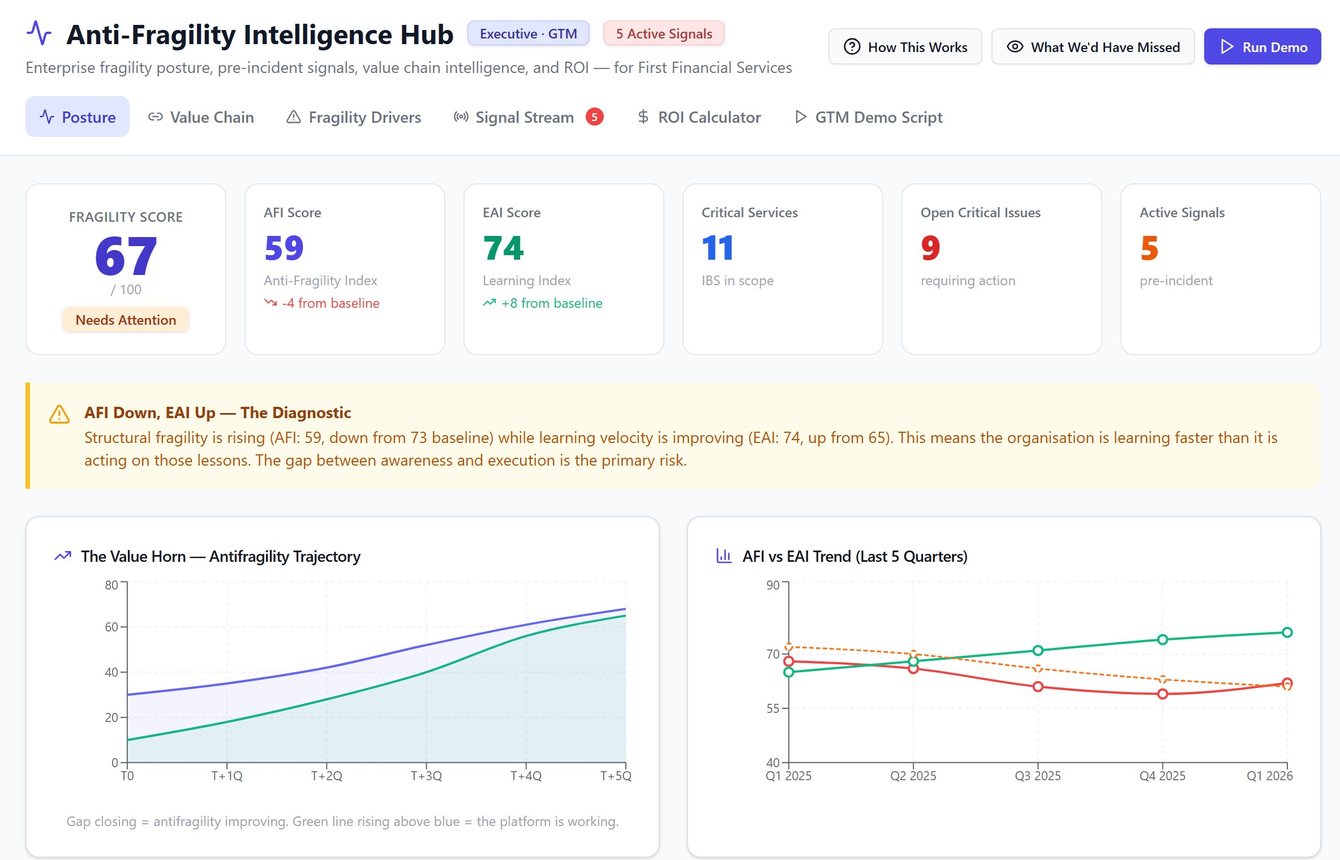
The Anti-Fragility Intelligence Hub.
Posture, pre-incident signals, value-chain intelligence and ROI — your whole operation on one screen.
Resilience is a posture. Anti-fragility is a number you can move. The AFI rolls five dimensions into one score, shows what’s driving it, and tracks it improving as your operation learns.
Fragility score, the Anti-Fragility and learning indices, and the value-chain trajectory — live, in one view.
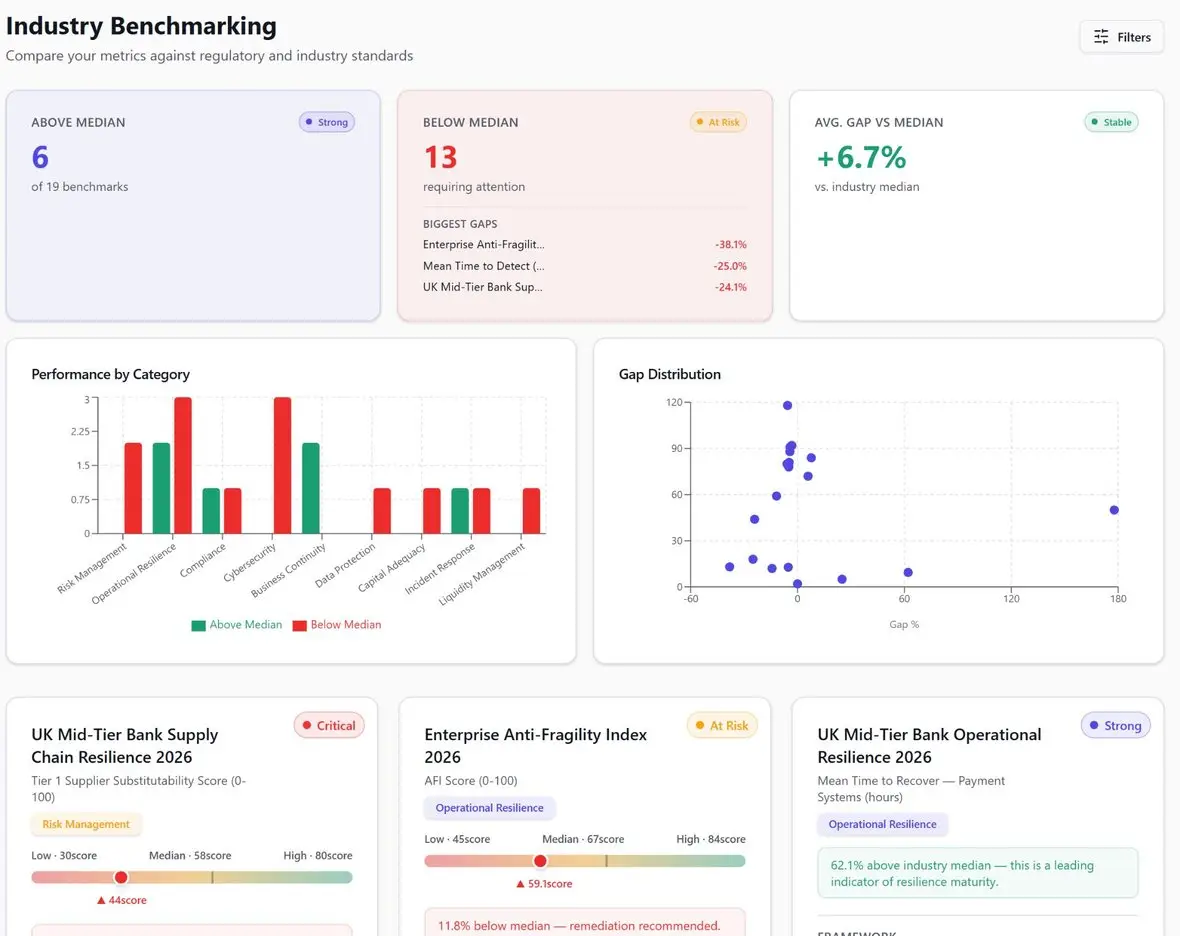
Industry benchmarking
See where you stand against the standard.
Built for operators, not just the Top 25
You already have the data. You need someone who can read it — and act.
Why CLDigital
Rip-and-replace
Common data model
Risk, supply chain, continuity and operations share one model, so signals are understood in full context.
No-code configurable
Built for the enterprise
Getting Started with Supply Chain Risk Management
If you’re building an SCRM program from scratch, start with your most critical products or components. Map the supply chain for those items first, identify the biggest vulnerabilities, and develop mitigation plans. Then expand systematically to cover more of your portfolio.
For organizations with existing programs, the opportunity often lies in deeper visibility (extending beyond tier-one suppliers), better integration (connecting risk data with operational systems), and faster response (automating detection and notification). Small improvements in any of these areas compound over time into significantly stronger supply chain performance.
Frequently Asked Questions
How is supply chain risk management different from supply chain management?
Supply chain management focuses on optimizing the flow of goods, information, and money to meet customer demand efficiently. Supply chain risk management specifically addresses vulnerabilities and potential disruptions within that flow. SCM runs the supply chain well under normal conditions, while SCRM prepares you for when conditions aren’t normal.
What is the difference between supply chain resilience and anti-fragility?
Resilience means returning to your previous state after a disruption. Anti-fragility means emerging stronger than before, using the disruption as an opportunity to learn and improve. A resilient supply chain survives shocks; an anti-fragile supply chain benefits from them over time
How often do supply chain risk assessments typically get updated?
Continuous monitoring is ideal, with formal reassessments at least quarterly for critical suppliers and annually for the broader network. Any significant change, whether a new supplier, a geopolitical shift, or a major disruption in your industry, warrants an immediate review of affected risk areas.
Does implementing SCRM technology require replacing existing systems?
Not necessarily. Modern SCRM platforms like CL360 integrate with existing ERP, procurement, and logistics systems. They aggregate data from multiple sources to provide unified visibility without requiring you to abandon investments in current technology.
Let's talk supply chain
See your supply chain's Anti-Fragility Index.
A short working session: connect a slice of your data, map the dependencies that matter, and watch a real scenario play out against your operation.